Showing posts with label Museums. Show all posts

Sunday, 26 September 2010

The British Museum

Website: http://www.britishmuseum.org

Yesterday, after my free Hare Krishna lunch, I visited the British Museum. I've visited the museum before but have never felt that I've seen very much of what's on display. This visit was an attempt to at least get an overview of its collections.

Part of the reason I wanted to visit the British Museum is that I've been listening to a Radio 4 series called The History of the World in 100 Objects. This is presented by the director of the British Museum and each 15 minute episode uses one object from the museum's collections to explain the history of some country or people or empire.

I felt the same sense of surprise as on my previous visits when I walked from the initial old-fashioned building into the modern geodesic-dome-covered courtyard:Even though I know this is what the inside of the museum looks like I always feel a shock - the courtyard and its roof look far too futuristic to be the 257 year old British Museum!

I quickly found a map and a guide to the 100 objects featured in the radio series. The 100 objects were spread all over the museum. This was both good and bad - good because it forced me to walk through displays I wasn't intending to see and bad because it made it very hard to see all 100 objects.

I set off to the first of the 100 objects - the Mummy of Hornedjitef - and found it in the midst of a busy room about the Ancient Egyptians. This was clearly a popular collection and lots of children were excitedly talking about the gory details of mummification.

My heart sank when I saw that the location for object 2 - a stone chopping tool - was a different floor at the opposite end of the building... At that point I decided I wouldn't be able to see all the objects and that perhaps I should just wander the galleries.

I took a detour to see a view of the courtyard and the roof from a high walkway:Dawdling through the galleries I came across some Babylonian clay tablets. I realised that, although I'd read about the Babylonian cuneiform writing system, I'd never actually seen any of it first hand. The first piece that caught my eye was a list of synonyms. I particularly liked the "ditto" marks that are used:Next to this was a piece which detailed the story of a huge flood with similar details to the Biblical flood story:
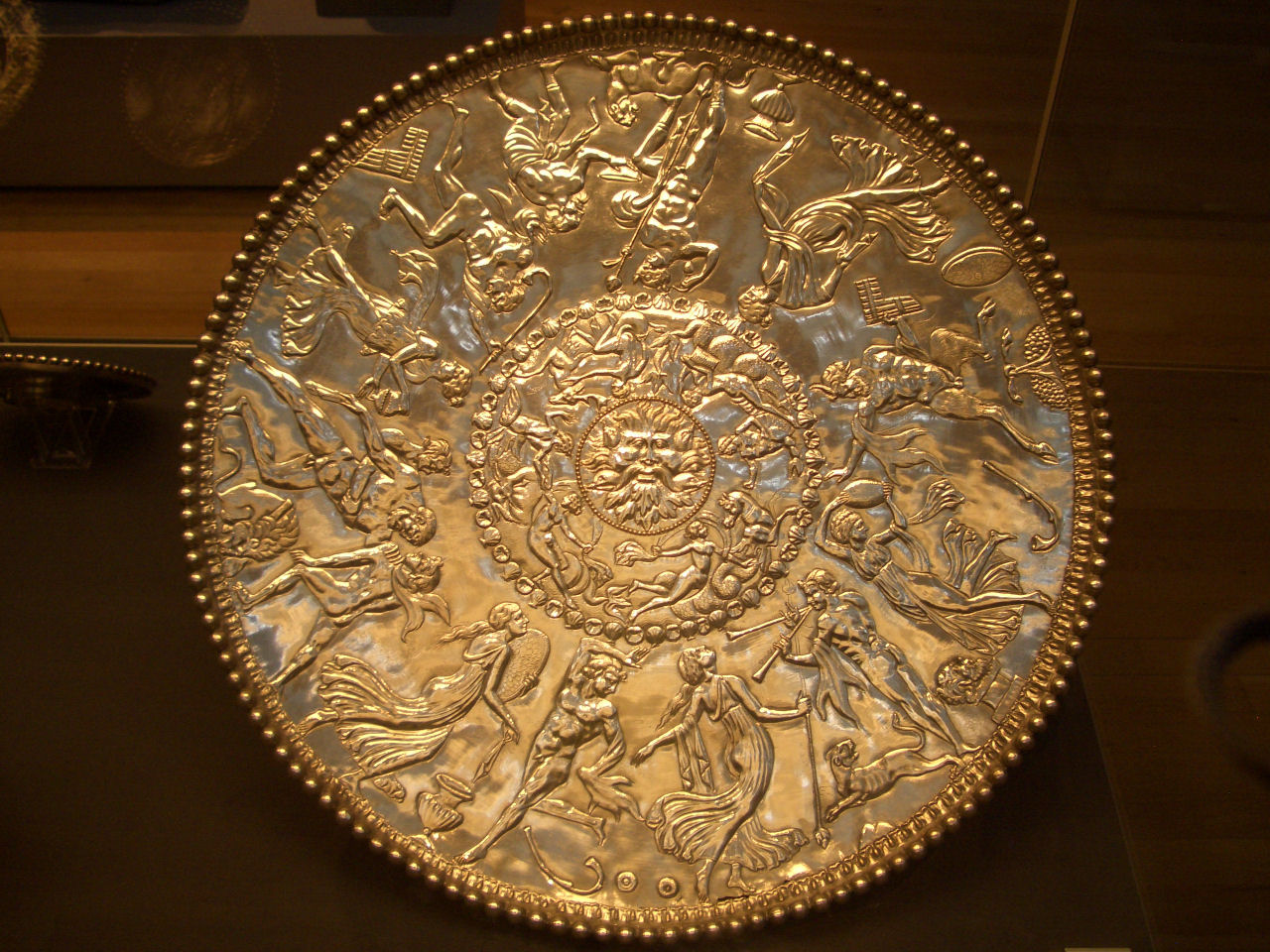
Pleased that I'd stumbled across something interesting I continued to wander aimlessly and found myself in a gallery about Roman Britain. This included an amazing "golden cape" that was found in a rich Roman's grave in Wales. There was also some very impressive metalwork from Roman times:
At this point I began to feel somewhat overwhelmed. More than that, I realised that this is what happens every time I visit the museum. I arrive in an optimistic mood, I see a few amazing and unique objects which trigger off all sorts of thoughts about the vastness of history, and then I start to feel overwhelmed and lose track of what era I'm looking at. Eventually I leave the museum feeling that I saw hardly any of the collection - I keep thinking about what other treasures I could have seen if I'd paid more attention.

Without following the dates I came across a pair of impressive drinking horns which I liked to imagine drinking from:I stopped taking photos at this point to concentrate on finding my way around. I passed through a whole room about the history of money, a glanced into a room all about clocks, a long gallery about the Ancient Greeks etc. At last I descended a grand staircase and saw that have items on display everywhere, even on the stairs:
When I emerged into a gallery again I was again in Ancient Egypt and saw giant stone sarcophagi, huge scarab statues etc.

By this point I decided to seek out a particular object I'd heard about on the radio show that sounded impressive. This was a double-headed serpent made by the Aztecs from around 2000 pieces of turquoise and shells! Having heard it described on the radio (e.g. how the red shells for the mouth were gathered by deep-sea divers) I felt I could appreciate it's beauty even more:After this I was completely done-in. I'd seen so many ancient and beautiful objects and each one had made me think about who had made it and how old it was and how they made it etc that I couldn't take in any more. I made one last dash through the "Age of Enlightenment" gallery back into the main courtyard. One last look at the postcards and I left.

Summary: A collection of historical artifacts that is exceptional in both quality and quantity. Definitely deserved several more visits.

Monday, 23 August 2010

Bank of England Museum

Website: http://www.bankofengland.co.uk/education/museum

Today I visited the Bank of England Museum on Threadneedle Street in the heart of the City of London. This museum is only open on weekdays so it's taken me a while to fit in a visit.

I didn't know where to go so ended up asking in the actual Bank of England. The doormen politely directed me around the corner to the actual museum. After a security check I picked up a guide pamphlet and set off.

The first stop was a surreal room that was made to look like the original Bank of England banking room from the 1800s. This included wooden counters and original decorations on the walls. The surreal thing was that in the centre of the room was a very modern exhibition about inflation called "The Pound in Your Pocket". Not sure where to start I read a few bits and pieces and tried to better understand inflation. Since 1992 one of the Bank of England's main jobs has been to keep inflation at 2%. They've had mixed success at this and the exhibition was heavily slanted towards explaining how difficult this task is.

At the side of the room were display cases exhibiting original, mint condition, coins from the last few hundred years. These included some from Queen Victoria:The exhibitions in the museum were arranged in chronological order but it was difficult to tell where to go to follow it in the right order. I took the next section in reverse. I learned all about the modern security measures in bank notes. I was impressed to use their testing equipment to see an ultra-violet "20" on the £20 note I had with me. From a computerised display I learned all about inflation and the difficulties it can cause if it's too high or too low. I also saw a printing press for bank notes: The next stop was a circular room which described the history of the Bank of England from the 1800s to the 20th century. I was lucky enough to follow it in the right order and found it all very interesting. I learned all about the Gold Standard (when the value of UK pounds was linked directly to a certain amount of gold in the Bank of England's vaults), as well as the financial turmoil caused by the first and second World Wars. Gradually it was explained how the current Bank of England emerged in the form it is today.

In the centre of the room was a collection of portraits of the Queen that have adorned bank notes over the past few decades. There was also a real bar of gold! This was in a plastic box and you could reach your hand in and lift it up. I have never held a bar of gold before and really had to struggle to lift it - it was very heavy! It was worth around £315,000.

After the round room I reached another room about the history of bank notes. This explained that they started as notes explaining how much gold you were entitled to from the vaults. If there were big disasters there'd be a run on gold - everyone would cash in their notes and get gold instead. The modern bank notes have evolved from those and no longer entitle the bearer to any gold unfortunately!After that I retraced my steps to the room I should have gone in first. This contained the early history of the Bank of England. I also came across the line-portraits that appear on current bank notes:
I emerged from the museum knowing a lot more about currency, money and central banks.

Summary: Interesting museum if you can make it on a weekday.

Sunday, 22 February 2009

Dickens House Museum

Website: http://www.dickensmuseum.com

Today I visited the Dickens House Museum near Russell Square. I'd seen the signpost in Russell Square pointing to the mysterious Dickens House Museum for years before but only managed to visit it today.

The museum is at 48 Doughty Street, a house where famed author Charles Dickens lived. His career was just taking off when he lived here and it was here that he wrote Oliver Twist and Nicholas Nichleby before moving house to a bigger place after he'd become rich.

To enter the museum you have to ring a doorbell and be buzzed in. I entered, walked through to the rear of the house and bought my £4 student ticket in the shop. I was told that the exhibition was in no particular order and I should just wander around.

First stop was the dining room at the front of the ground floor:
This is apparently where Charles Dickens hosted hundreds of fun dinner parties with famous actors and writers of the day. There were lots of pieces of furniture he owned on display (including, for example, two monogrammed knife holders). I've only read two Dickens stories so I wasn't sure if I was under-prepared for a museum about him. As it turned out, the museum focussed fairly squarely on his life and not so much on his works.

The next room had a lot of portraits and photographs of Dickens and his family. He had 9 children and an affair - quite an eventful family life... There was an interesting sequence of about 20 photos showing Dickens from young to old. There was also an interesting stereographic image of him which I tried to view (unsuccessfully) in 3D:
After this room I went to the first floor for a quick look around. Here I learnt that Dickens wrote so quickly that he didn't have time to plan the plots in detail - he just figured it out as he went. I also learnt that his books were first published in monthly instalments:These monthly instalments are prized by collectors and it sounded like the stories were written month-by-month, sometimes having reader's comments incorporated into the plots. Some "desk furniture" that he used was on display and included a china monkey which was one of Dickens's favourite pieces:I had a quick glance at the front study before rushing down to the basement to catch the start of a half hour long film about the life of Charles Dickens. I learnt that when he was about 10 years old his family fell into bad debt and were put in a debtor's prison. He got a job in a factory labelling boot dye and went to visit them in prison. It sounded pretty grim but, or so the film suggested, it was these bad experiences that enabled him to write such great stories.

He was first published under the pseudonym Boz before writing for a newspaper and then publishing the Pickwick Papers. These became a great success and he became famous. He kept up a high output of work and, by the time he died, was hailed as a national hero.

After the film I looked at the top floor but I was getting a little bit tired of the museum. All the information was written in little snippets around the walls - it was quite an effort to put the whole story together. Important pieces of information were just as prominent as dull/unimportant pieces (e.g. "This clock belonged to a friend of Charles Dickens" vs "Dickens campaigned for...").

One highlight I suppose was seeing his Reading Table. This was carefully preserved in a dimly lit room and was designed by Dickens himself. He used it in public readings of his work which he was paid enormous amounts of money for.
I took a brief look outside at the nice garden before leaving.Summary: Interesting bits of history about the life and times of Charles Dickens. Could do with some more general introductory material. Makes you realise that people who achieve great success almost always work really really hard to do so.

Saturday, 7 February 2009

The Guards Museum

Website: http://www.theguardsmuseum.com

Today I visited the museum that inspired this blog. The museum is located next to St. James's Park and, as I arrived, I was expecting a museum about soldiers and warfare. I was partly right.

I bought my cheap £2 student ticket from a softly-spoken grey-haired gentleman who waved me into the museum. I was immediately confronted by huge displays of medals and uniforms:I tried to read the information cards to understand what I was looking at but they assumed a level of background knowledge that I didn't have (e.g. the technical meaning of battalions, colours, decorations etc). As I made my way around the museum I found longer information signs which gave the necessary background.

It turns out that the museum is all about a very particular type of soldier: the Royal Foot Guards. More specifically the five different types of Guards: Grenadier, Coldstream, Scots, Irish and Welsh Guards. I finally understood that these were the same guards as in the "changing of the guards at Buckingham Palace". I think of these as mainly a tourist attraction but the Guard's regiments are proper soldiers too and there are some currently in action in Afghanistan.

The Scots and Coldstream guards were founded in the English civil war (the Scots guards were first assembled in Scotland and then marched for over a month south to London!). These soldiers used pikes to spear enemy cavalry charges. The pikes were long wooden sticks with a metal point on the end which was used to pierce horses and their riders. Rather gruesome was the mention of a "blood rag" which was tied around the stick to "stop blood running down the shaft and making it slippy". Ugh! (The blood rag was later "formalised" to a tassel).

Over the centuries other regiments were added (Grenadier, Irish, Welsh - in that order I think) by various kings and queens. The museum charted the history of the regiments and the different battles they've fought in. The timeline reminded me of the bloody history of Europe - with countries declaring war on each ceaselessly. There were lots of paintings of battles and uniforms through the ages: even including the battles fought in Egypt: Eventually I made it through the extensive rooms to the 20th century where The Great War, World War II and beyond were discussed:I was interested to see their display about the current regiments in action in Afghanistan:This formed an striking contrast to the ceremonial aspects of the uniforms, the "colours", the drumming parades etc. After a quick look around at the photos of the stiff-upper-lipped military leaders, I left.
Summary: A bit too specific for a day out unless you know someone who was in the Guards.

Sunday, 6 July 2008

HMS Belfast

Website: http://hmsbelfast.iwm.org.uk

Today I visited HMS Belfast. This is a Royal Navy ship which has been moored near Tower Bridge since the 1970s. It saw active service in World War II and the Korean War and is now a floating museum about its naval history. I'm not much of a military buff but thought I'd give it a visit.

When I arrived I found the ship was so big it couldn't fit in one photo. Clearly a montage was required:
I bought a student ticket (£7.20), got a free English language audio-guide and set off along the jetty out to the moored ship. At the end of the jetty a uniformed Navy officer took my ticket and, calling me "Sir", gave me a map and a brief, official-sounding orientation. Then I was on my own.

I tried to figure out if there was a "tour start point" but the map was no help so I tried the audio guide. Holding the over-sized phone to my ear I felt like a genuine tourist. Although the guide was interesting (for example the ship's bell was also used as a christening font for the sailor's babies) and included excerpts from veterans who served on the ship it went a bit too slow for my liking so I slung it around my neck and set off without its aid.
My first stop was Gun Turret Y at the stern (i.e. back) of the ship. Here the awesome guns were on display. These were used to fire huge 6 inch shells out at the enemy and were manned by a crew which, when there was action, worked, slept and ate in the turret. A father and son were in the turret with me and I benefited from the father's explanation of how the guns worked.Next stop was inside the ship where a TV display explained all about torpedoes. The Belfast used to carry 6 torpedoes and there was a huge one on display. I watched a French tourist pose for a "ride the torpedo photo"...

I tried to follow the arrows around the ship but it turned out a new tour route was being trialled. This meant there were conflicting old and new arrows pointing in contradictory directions. I did my best and went down to the Boiler Room and the Engine Room. The complex and immense machinery was amazing. The boilers produced super-heated steam to power the turbine engines which powered the ship's propellers. It took 4 hours to get up enough steam for the ship to start off! These rooms were fun because you were allowed to climb up and down ladders and steep steps. There were narrow walkways suspended between pipes and dials. It was a cross between a museum and an agility course.

I got turned around with the ladders between decks and the confusing arrows and the occasional signs sometimes declaring "You are now below the water line". Rather than try to reconstruct my route around the ship I'll give you the highlights. The best one was the insight into the little things you don't think about but are essential to the running of such a massive ship. The Belfast had a bakery, a butchers, an immense galley to cook for everyone, a clothes store, a small shop selling sweets, a dentist, a sick bay, a post room, a music broadcasting room (to play music to entertain the men), a chapel etc etc. The galley ovens were enormous. One huge, deep "copper" was filled with hundreds of fake potatoes to give you a rough idea:Everywhere there were models of people acting out the relevant task: people having teeth pulled, baking, butchering, even a model of someone having an operation. I learnt that there were cats on board to catch mice and rats and that the soap and tobacco were stored separately from everything else (or else they'd taint the food). A reindeer given to the ship as a present by the Russians in WWII was so scared by the gunfire that they had to "put it out of its misery" a few days later. I believe it ended up as reindeer pie...

The ship turned out to be so huge that I began to tire of climbing between decks and reading the information boards. I saw the shell stores where the explosives were kept and learnt about how they were hauled up mechanically to the gun turrets above. I took a short break to have a snack in the Walrus Cafe before my final assault. The tour lead to the mess area were sailors used to sleep in hammocks and play cards. I saw the punishment cell where sailors were locked up by the captain for misdemeanors including falling asleep on watch. A quick look at the bow (i.e. front) and the impressively huge guns. They are capable of firing shells 14 miles away! Currently the guns are aimed at a service station on the M1...It was starting to rain now so I did a quick look through some parts I'd missed. These included a mechanical computer that calculated where to fire the guns in order to hit the targets:
It sounded very complicated - wind speed, wind pressure, how many shells had been fired by the guns, the targets speed and direction were all taken into account. I was also surprised to see that the ship was steered by an old-fashioned steering wheel:
(For some unexplained reason the sailors on the Belfast wore full head-covering white balaclavas...)

Summary: A surprisingly fun day out with lots to see. It's good fun to climb around the ship and pretend you're on a seafaring adventure.

Saturday, 21 June 2008

London Transport Museum

Website: http://www.ltmuseum.co.uk

I've been so busy for the past three weeks I've had no time for my Local Tourist trips - until today! I'm not sure... maybe it's because it was on my list, maybe it's the thrilling name of the museum or maybe it had something to do with their latest extensive advertising campaign but today ABJ and I visited the London Transport Museum in Covent Garden.

After buying our £6 student tickets we entered a mysteriously modern red-neon lit corridor:
This showed video clips in the walls about transport systems in other cities. We walked up the ramp and found, at the end a huge London tube map on the wall. Round the corner were two lifts and signs saying "Continue your journey this way..." We got in the lift and pressed the button. The doors closed and it was like being in a space rocket crossed with a time machine crossed with a lift. Suddenly the years spun back in time and we were blasted upwards to 1800 (a.k.a. Floor 2).

Exploring the museum was made a lot easier by arrows painted on the floor. Following these we learned all about the time when London had only one bridge across the Thames. The river was busy with steam boats and there were lots of accidents.

We learned about the rise of the railways in London. When first built Euston and King's Cross were on the edge of London and one could walk half and hour in any direction from Westminster or St Paul's and be in the countryside. Ah, those were the days.

To transport people from the train stations to the centre there were horse-drawn cabs and omnibuses. These cabs, buses and trams needed 50,000 horses to run them all and these produced over 1,000 tonnes of dung daily.

Travelling down to Floor 1 we followed the development of the London underground. Trains were built underground to ease congestion on the roads and avoid the demolition needed to build new railways. A big problem with railways underground was how to avoid smoke and steam from the engines. Numerous attempts were made (including trying to power a steam train with hot bricks) but the problem was only completely solved by electrifying the underground railways in the early 1900s.

One of the best pieces on this floor was the wide range of posters that promoted travel on the underground railways to its punters:
We finally made it back to the ground floor which dealt with London transport in 1900-2000. This started with an explanation of the first deep underground tube lines which presented a host of engineering problems. One of these required the invention of the escalator to move people from ground-level deep down to the underground trains.

There was a piece about the unified style of the London underground - from tube station builds to uniforms to lettering...
Best of all was the opportunity to drive a virtual tube train through a computer generated simulation of the Northern line. While we waited this was being monopolised by some punk kid who couldn't even stop correctly at the end of the station platforms. When I eventually had my turn I drove into Tottenham Court Road and pulled to a gentle stop at just the right place... Who knows, maybe I missed my ideal career...

In a big gallery on the ground floor were lots of buses from different times. We climbed in and around these and lamented that loss of the Routemaster bus.

Summary: Surprisingly fun. Well organised layout and interesting information.