Showing posts with label Tours. Show all posts

Monday, 6 September 2010

Tour around the Albert Memorial

Websites:
http://www.royalparks.org.uk/parks/kensington_gardens/tours
http://en.wikipedia.org/wiki/Albert_Memorial

Yesterday ABJ and I went on the a tour around the Albert Memorial in Kensington Gardens. The tours are held on the first Sunday of each month from March to December and are £5 per adult.

We turned up for the 2pm tour and paid our money to the blue-badged tour woman who gave us a hand-written ticket from her ticket-book. There were around 20 people waiting for the tour - the group had an average age of around 60.

Unfortunately the start of the tour was a bit shambolic. The tour guide was in a panic because she had been unable to get through on the phone to the park security to tell them to turn off the alarm on the memorial. Her worry was that when she went to unlock the railings around the memorial a loud alarm would go off and chaos would ensue. She therefore spent the first 5-10 minutes on and off her mobile phone desperately trying to get through to the park security or find the correct number for them. This fiasco led one German man to lean to his wife and say "Ah, English administration..."

Anyway, at length the tour began and we were ushered in front of the memorial. This was built after the death of Queen Victoria's husband, Prince Albert, to honour his memory. The original plan was to build a giant obelisk on the site of the Great Exhibition in Hyde Park. As it turned out, however, nowhere in the British Empire could quarry a large enough piece of stone. When the planners told this to Queens Victoria she said "Oh, that's good - I didn't like that design anyway..." After that a competition was opened for designs for the memorial. Most of the designed entered were classical - lots of columns and pillars - but the design that was chosen was more "medieval", inspired by the Eleanor Crosses.

The memorial itself is extravagantly detailed and the tour spent a lot of its time explaining the meaning of the different statues, mosaics etc. The mosaics on each of the four sides represent Literature and Music, Painting, Architecture and Sculpture. The statues at the four corners of the base represent the continents Europe, Asia, Africa and America. There's also a host of other statues representing things like chemistry, agriculture, humility etc. The continents were illustrated with one animal (there were lots of arguments about which animal should represent Europe - in the end a cow was chosen).

There was elephant for Asia:a camel for Africa:and a bison for America:We heard that underneath the base of the memorial is lots of concrete as well as numerous supporting brick arches. The stone for the memorial came from all over the British Isles and we heard where the different coloured stone for the base came from (something I'd never thought about whenever I've walked across them):The group was led further around the base and shown more details on the statues and the mosaics. It was interesting to learn that the north face focusses on architecture and the mosaic shows someone holding up the plans to the memorial itself!The group were now allowed to go beyond the railings and up the steps of the memorial.
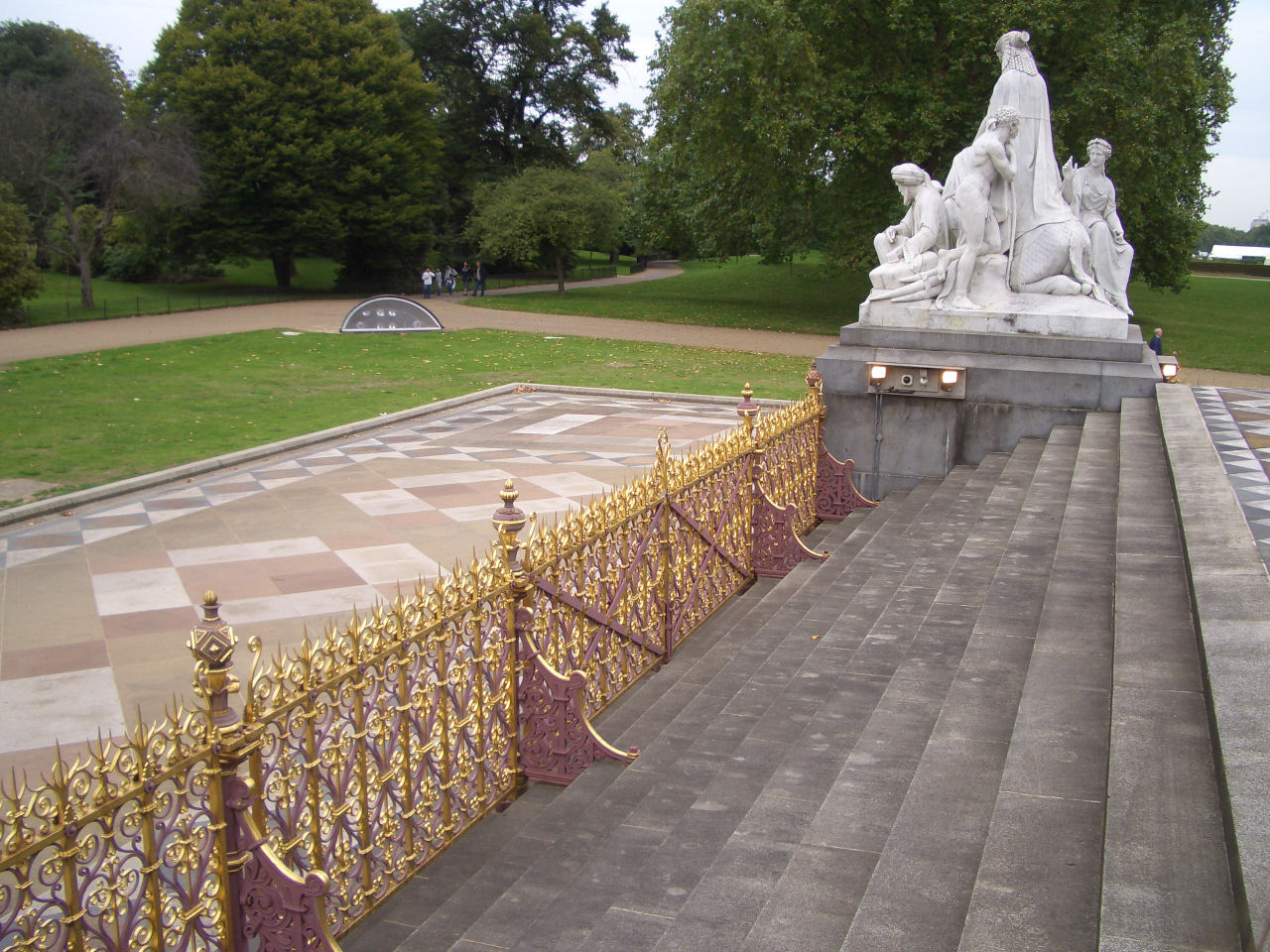
This was the best bit of the tour because it meant that we could have a close-up look at the detailed carvings. Around the base of the memorial there was an intricate series of carvings depicting famous artists, architects, sculptors, musicians and writers. This carving was performed on site over a period of 4 years! Here's an example of the series of famous architects:
Being closer also allowed us a closer look at the centrepiece - the statue of Albert himself. This was made of bronze and covered in gold-leaf. It was added to the monument years after the building work was completed because there was such a debate over what the statue should look like. It was chosen that he'd wear the uniform of the Order of the Garter which is why he has a prominent garter on his leg:
He is also holding a catalogue of the Great Exhibition which he organised (you can even read the title on the front):
After a few more explanations about statues etc our hour long tour ended. We all felt we had a much better appreciation of this amazing memorial.

Summary: Lots of detail to see if you know what you're looking at.

Monday, 1 February 2010

Bevis Marks Synagogue


Website: http://bevismarks.org.uk

Yesterday ABJ and I visited the Bevis Marks synagogue, the oldest surviving synagogue in the UK. It's been operating for 308 years, ever since its completion in 1702.

We'd investigated visiting times on their fancy website but yesterday the site was down and was replaced with a very basic one with little information. We finally ended up phoning them and were told the opening hours were 10.30am-12.30pm on Sundays. We hurried across London and arrived at about 11am.

We were greeted by a tough-looking Polish bouncer. He charged us the student admission of £2 each before letting us in. Excitingly I had to cover my head with a yarmulke picked from a basket near the entrance. This was the first time I'd worn anything like this.

Entering the synagogue I found it was smaller than I'd expected. For a building with such an illustrious history I was expecting a huge cavernous interior. Instead it was the same size as a medium/small church.

Apparently there'd be a tour shortly so ABJ and I spent the time exploring. We examined the original English-oak furniture which has been used for hundreds of years. Unfortunately we exhausted the interior in about 5 minutes so sat down and watched the other visitors.

Eventually a walking tour group arrived and a man emerged from a side-door to give them the tour. We tagged along and all sat on the centre benches. The tour guide was a friendly man in his 50s who'd been associated to the synagogue for a long time (he said he'd been in the choir when he was 6!).

We heard how the synagogue was built by Spanish and Portuguese Jews who'd fled the Spanish inquisition to Amsterdam before travelling on to London. We heard about how the seven chandeliers represented the seven days of the week with the largest one for the Sabbath. The guide explained that a lot of the building and carpentry was done by people who built churches. He pointed out features of the synagogue which were identical to English churches of the same period and even, he suggested, completed in the same workshops!

The guide told us about some famous Jews associated with the synagogue including Prime Minster Benjamin Disraeli and rich philanthropist Sir Moses Montefiore (who is so respected his seat is roped off as a memorial). When the guide had finished we left the synagogue, dropping of my yarmulke on the way. While waiting outside we heard the leader of the walking tour referring to the synagogue guide: "He's a very nice man and it's all very interesting but he doesn't half go on a bit...!"Summary: A small taste of London Jewish history.

Monday, 24 August 2009

Kensington Palace

Website: http://www.hrp.org.uk/KensingtonPalace

Yesterday ABJ and I visited Kensington Palace. As I work nearby I've been past the place hundreds of times but I'd never actually been inside. It turned out that you got a discount of £1 if you booked your tickets online so I booked two £10 student tickets before we set out.

It was a sunny day and we arrived in the busy Kensington Gardens, entered the main approach to the palace and found the ticket desks around the back. We picked up our tickets smoothly and got out audio guide.

Unfortunately the audio guide hand-held wand was quite uncomfortable - there was a big nodule sticking out which you had to hold against your ear. It was just too big to fit inside your ear and just too small to rest your ear against, instead you continually bashed your ear lobe against it as it rattled in circles around your outer ear as you wandered the hallways. Not only that but when each audio entry finished there was no signal - just silence. This led to us holding the wands to our ears in humble uncertainty for 5-10 seconds after each entry. We set off and learned about the ceremonial costumes that young men and women used to wear. The costumes on display were original and some were very impressive - lots of gold embroidery. Some of the more ceremonial aspects seemed very pointless - the worst beinga flattened hat which couldn't even be worn but had to be carried tucked under the arm as a sign of respect to the monarch.

There was a mock-up of a upper-class tailor's showroom where you could inspect the fabrics they used and see colonial uniforms on display. A few more rooms showed original laces and a sewing workshop. It was interesting to learn how immense the effort was to make many of the garments on display - many young women working in terrible conditions to make the finery for the upper-class. ABJ did some arty photography: We were then treated to room after room of dresses that Princess Diana had worn. This seemingly never-ending parade of 80s and 90s dress styles is one of the main attractions to the palace but I found it fairly dull:From this point on, in fact, the exhibits became more and more strange. There was a focus on débutantes - the young upper-class women who were presented to the King and Queen. This included a series of video interviews with the "last debs" - the practise ended in March 1958 so many of the girls presented are still alive:There were lots of old photos of "debs" and "debs delights" (i.e. the men who dated/danced with the debs) but they didn't have very useful captions - no dates or other handy info. The structure of the exhibits became more unusual - the path became non-linear and poorly signposted and the displays of dresses looked more and more like they'd been dreamt up by a exhibition designer left to run wild. There were huge cardboard cutouts of women curtseying, dresses displayed in rooms with mirrors on the walls, a giant 10ft tall fabric wedding cake etc etc.

After a room where you could practice walking in a straight line with a book on your head, learn how to reply to a party invitation, how to curtsey etc, there was a room with authentic nik-nacks from the good old days (e.g. "I bought these bras in Paris" etc).

We then transitioned from debs to the history of the palace and were treated to a long series of dark wood-panelled rooms with lavish tapestries and paintings. One featured a "fat Venus" and was the cause of a dispute about displaying such a grotesque painting:
There was a chance to see the view over the gardens from inside (rather than my usual view from the gardens looking in): We toured the long line of similar rooms and marvelled at the fancy furniture. One room had a "wind dial" - a device that displayed the prevailing wind direction through a connection to a weather vane on the roof:
We were impressed by a "lantern" in the ceiling of one room/floor of another which we decided we should have in our house one day...At length our tour ended in the busy perfumed gift shop. We took a last look at the impressive but hidden gardens:and were then on our way.

Summary: To expensive for such a poorly put together tour.

Saturday, 11 April 2009

London Duck Tour

Website: http://www.londonducktours.co.uk

Today I went on the London Duck Tour. Tickets have to be booked weeks in advance so, thanks to VB, we were booked in to go today. We turned up early at the official bus stop near Waterloo station:We were soon seated on the bright yellow duck bus. Although the seating was a bit cramped everyone was in high spirits - they were all excited about the unusual tour that awaited them.

The tour was due to start at 1pm so at the appointed time a man climbed on the bus, walked to the front and introduced himself: "Hello, I am Ivan, being your tour leader today. I from my Ukrainian republic. Thank you, please." We all looked disappointed that the tour guide was unable to speak English properly but then he sat down and said "Hi, I'm Nick!" in a fluent English accent.

After a few introductory "Where is everyone from!?" questions, we were on our way. We first learnt that the Borough of Lambeth was named after "the place where lambs birth". We then set off towards Westminster and passed a big protest: The tour guide cracked a lot of good jokes about Big Ben and Boudicca. I was impressed with his knowledge of the different statues on display in Parliament Square and Whitehall.

We passed up through Trafalgar Square: and then drove along Pall Mall (named, apparently, after an old-fashioned croquet-like game called Palle Maille). We were told about the weird things inside all the grand buildings we passed (e.g. a big swimming pool in one of them where the Queen would go swimming). Up next to Piccadilly we passed the Ritz hotel. Apparently Charlie Chaplin once worked here but was fired after sliding down a bannister...

Past Green Park we learnt it was built on a leper cemetery (which is why it's green - the gardeners didn't want to dig down to make any flower beds!). Past Wellington Arch:We went down past Buckingham Palace and through to the river again. We crossed Vauxhall Bridge and approached the imposing MI6 building. This was the unexpected river-entry point. We pulled into a little road just next to MI6 and our road driver got off and our "waterman" got on. Without further delay we were moving forward, speeding down the ramp to the Thames and SPLASH! we floated down into the water:Luckily the water didn't come in through the windows. We chugged along the Thames towards the Houses of Parliament and kept a pace with two canoers: While on the river our tour guide told us some facts and figures about the river (e.g. how many fish species are there, it's history, it's name (from an old Latin word for "dark" since it's so muddy)). It was fun to see the sights from waterlevel and the river-facing decorations:Unfortunately we didn't go any further down than the Houses of Parliament before turning around and leaving the river where we entered. We were soon back on the road and heading back towards where we started. We learnt that the Kinks song "Waterloo Sunset" was written while Ray Davies was recovering in St Thomas' Hospital.

During the ride we attracted a lot of attention from the general public due to our flamboyant vehicle:There was also a few opportunities for some arty photos:
Summary: It's fun to do a tour of the city you live in - even more so in a duck boat. I enjoyed the trip - especially because of the lively jokes from the tour guide.

Sunday, 15 February 2009

Tour round BBC Broadcasting House

Website: http://www.bbc.co.uk/tours/details/details_bh.shtml

Today I went on a tour around BBC Broadcasting House. Unfortunately I forgot to take my camera with me.

To go on a tour you have to book in advance so I already had my £4.40 student ticket with me when I set off. I arrived just before my 2.10pm tour and was told to take a seat with the other people in the group. I sat in the plush waiting area and started to look through the BBC in-house magazine: Ariel. One particularly interesting story was by a novelist trying to encourage the BBC to do more to promote science. He said "I know only a tiny bit of science and nobody holds it against me... Maybe they should". Well... I hold it against you. But anyway...

At the start time for the tour we were welcomed by our two tour guides: Sarah and Adrian. They checked us off a list and then got us to write our names on a sheet of paper "in case there is an evacuation". We were then taken back outside by Adrian and stood on the steps of All Souls Church to face the Broadcasting House building.

He ran through the history of the nice art-deco building from it's official opening in 1932 to the present redevelopment. Above the main entrance stands a prominent statue of Ariel and Prospero from the Shakespeare play the Tempest:This was sculpted by Eric Gill (who also made the typeface for the current BBC logo: Gill Sans) and there were suggestions that it was really depicting God and Son. The sculptor apparently told people that there was a secret in the work that would not be discovered until the building was knocked down. Well, too bad for him but during some restoration work they put a camera behind the statue of Prospero and found a hidden carving of a woman's face. Weird.The building has been likened to a top hat (with the rim being the pavement) or a ship sailing down Regent Street.

We finished looking at the outside and then went back to reception. Here we got to see the original octagonal BBC logo made as a mosaic in the floor. Originally the BBC stood for British Broadcasting Company before it became British Broadcasting Corporation. I'm not too clear on the difference. We then set off through security, to the toilets and then on our way...

First stop was the Radio Theatre. This sits in the centre of the building with offices wrapped around its outside. In the past few years it's been renovated to make it more accessible. This involved raising the floor by about 2 metres. We all sat in theatre-style seats and looked at the stage which had a few plain chairs on it. Everywhere microphones and speakers hung from the ceiling. We were told that most radio shows are pre-recorded now and a lot of them are recorded in the Radio Theatre. We saw a photo of the theatre being used as a bomb shelter during World War II - with men and women separated by a big curtain at night time. The building was actually hit by a bomb in WWII during a news announcement...

The next stop was by the (renovated but original) lifts. Here we saw a huge tapestry that had been given to the BBC by France to honour the BBC for it's help to the French resistance. We then visited the plush Council Chamber where all the BBC's decisions are made.

We then took the stairs up to some recording studios. This was my first time inside a recording studio and I was impressed. Although it wasn't as flashy as I'd imagined (if anything it was a bit cramped when all our group was in there) it looked like it was used by people who know how to do their job well. The walls were designed to avoid reverberating sounds and there were synchronised clocks everywhere you looked so people can announce the correct time-check on air. The studio we were in is where "Woman's Hour" and "You and Yours" are recorded. We visited another recording studio (where "Poetry Please" is recorded) before arriving at a bigger studio that had a piano and "enough space for a small orchestra".

We then went to the top of the building and out onto a little roof terrace. This was really nice and had a fantastic view. We were told about how the BBC was in Phase One of the redevelopment of the area. This included, for example, a Persian and Arabic broadcasting building next door. Unfortunately it began to rain so we went back inside and were told in more detail about the "Breathing Sculpture" on the roof:This was made as a memorial to all the journalists and crew that have been killed in war-reporting. The text that spirals down the cone says:

life turns and turns on the crystal glass
breathing in our body

silence is a voice, our voice
silence is a body, our body

life turns and turns on the crystal glass
breathing in our body

I invite you to breathe
I invite you to listen to the silence

We then went down to the most fun part of the tour. Our group got to record a mini radio drama. Six volunteers were chosen to either read parts of a script or do electronic or physical sound-effects (e.g. corks popping or gongs bonging). The story of the drama was about a couple breaking down on a dark country road and walking to a spooky country house for help. The butler ominously welcomes them in, gives them champagne and then says "It's time for dinner... and the dinner is YOU!".

We watched them perform it and then listened to it again. It sounded impressively professional on the played back version - apart from some mix-ups with the sound effects and some badly delivered lines. The star of the show was the "Annoucer/Butler" played by a deep-voiced German man. He sounded very professional and really delivered his lines well.

We then returned to the reception, returned our customer satisfaction forms and departed.

Summary: Very interesting - would recommend to anyone who's ever listened to the BBC radio stations.

Sunday, 8 February 2009

Tour around the Royal Albert Hall

Website: http://www.royalalberthall.com

Today I went on the 10.30am tour around the Royal Albert Hall in South Kensington. There are multiple tours everyday but today there were only 2 in the morning because "Cirque du Soleil" was showing in the afternoon.

I've been to quite a few shows at the Albert Hall (including a Cream reunion concert, ballet, the proms, indoor tennis... even my graduation!) so I was looking forward to learning a bit of "insider information".

The tour started promptly at 10.30am. About 15 of us were hanging around Door 12 when we were greeted by Helen who's worked at the Albert Hall for 10 years. She asked everyone if we'd been to the venue before and where we were from. There were people form Australia, Sweden, Germany and, slightly less exotic, Bedford. Helen explained that we were not allowed to take photos and then led us away from the Box Office into the circular corridors on ground level.

Lining the corridors are photos of famous or unusual performances at the Albert Hall and, as she led us up to see the boxes, she explained that sport has been very big in the venue's history. They've had tennis (during the Masters Tennis)basketball, sumo wrestling and even a marathon (In 1909 two athletes tried to run 500 laps of the inner corridor on a bedding of coconut leaves. Neither made it!).

We were led upstairs to sit in the boxes overlooking the stage. Here we had a rest in the chairs and were taught some history of the hall. It was opened in 1871 and was designed to be an amphitheatre with a roof. The roof ended up causing enormous difficulties however because it echoed the sound around the performance space. This was good if a choir was singing but bad if there was a soloist or pianist. People would apparently say "It's good value for money at the Albert Hall - you hear the concert once and then again 2 or 3 seconds later...". The modern solution to these echoing difficulties was put in place in 1969. It involves a host of upsidedown "mushrooms" suspended from the roof: These scatter the sound waves all around the room before they can get to the roof. Any sounds that do get to the roof then bounce back into the mushrooms and are dampened down.

The hall hosts around 360 events every year and has a audience capacity of 4,500 to 6,000 depending on the event.

We then left the boxes we were in an took a sneak peak at the Queen's box. This was bought by Queen Victoria and has a prominent crown displayed above it. It is where royalty sit when they come to an event at the Albert Hall but, when there's no royals attending an event, the box is used by people that work for the Queen (e.g. stable hands at Windsor, secretaries at Buckingham Palace etc). It seems like it's a perk of the job.

This Queen's box (which is always called the Queen's box even when a king is monarch because it was Queen Victoria who bought it) opened up the whole issue of ownership of seats. To raise money to build the Albert Hall they sold a few hundred seats for £100 each. The lease for these was 999 years (!) and the seats were passed down through families. In the 137 years the Albert Hall's been around a lot of the seats have, however, ended up being bought as investments by companies and banks. They are occasionally sold by closed auction in the Times but prices are high. One couple on the tour said they saw 5 seats sell for £100,000 a few years ago. If you do own a seat you get to go to pretty much any event you like...

We then visited the Royal Retiring Room where royalty come to relax before and after a show. This has portraits of all the leading royals since Queen Victoria. Here we were told that the Albert Hall was built as a memorial to Prince Albert by his widow Queen Victoria. Albert had conceived of turning South Kensington into a centre of culture and science. After his death the plans were followed through and the Royal Albert Hall, Royal College of Art, Imperial College, Royal College of Music, National Geographical Society, Science Museum, Natural History Museum, Victoria and Albert Museum were built. This vast complex was nicknamed "Albertopolis".

We then climbed up to the "Gallery" - a standing-only viewing area that rings around the top of the auditorium. This is fairly plain now but used to be the social area with paintings on display (hence "the Gallery"). We took a quick look out at the closed-off balcony before descending the stairs again. We'd been asking so many questions we were in danger of making Helen late for her 11.30am tour. She led us back to Door 12 and said goodbye.

The hall used to be powered by steam and the chimney outside is the disused (but listed) steam vent:Summary: Interesting glimpse into the history of the place. Could do with some more "behind-the-scenes" restricted access.

Saturday, 18 October 2008

Tower Bridge

Website: http://www.towerbridge.org.uk

I've tried twice to visit Tower Bridge but each time something has gone wrong. I finally managed it today.

At about 2pm I bought my £4.50 student ticket from the ticket office in the north tower. I passed through the security metal detector and x-ray machine and into the waiting lift. We waited for the lift to get full wall-to-wall and then ascended to the top of the tower. A woman gave us an informative welcome message which was timed to last exactly as long as the lift journey and then we all exited into a video room at the top of the tower. There were good views:I watched a short film about why the bridge was built and the competition for the best design. It was built to easy road traffic in the east of London but also had to allow ships to pass. There were loads of wild and wacky designs - including bridges that slid back and forth across the river, or bridges that snake around the ships in complicated shapes. After fierce scrutiny the current hinged design was chosen. It was built from Scottish steel with 2 million rivets and opened at last in 1894. It was deliberately designed to look old-fashioned to fit in with the Tower of London nearby.

After the video room we got to walk out on the walkway that connects the top of the towers. I didn't know this was a walkway until today (I'd thought it was just for decoration). This was great and I was impressed by the views over the river. The walkway was enclosed but there were windows that we could take photos through:
There were information boards too where I learnt a lot about the bridge. The bridge has appeared in a few adverts:
A plane flew through the bridge:
After World War II there was a suggestion to encase the bridge in glass to provide living space and offices etc:After the walkways I went down the south tower to watch another video about how the bridge was built. I learnt that in World War II the Germans deliberately tried not to bomb the bridge because it was a good landmark for their bombing approaches into London.

I got the lift down the tower and we were told to "Follow the blue line" to the engine rooms:
The engine rooms were the final stop of the tour but possibly the best bit. We learnt in detail about the machinery that powers the raising and lowering of the bridge. We got to walk around the steam-powered machines (which have now been replaced by electric power) and understand how all the stages fit together. I found it fascinating to see how complicated it all was and how clever the engineers must have been to design it.

The last part was the "Engineering gallery" with a number of hands-on demonstrations about physics and engineering principles applied to small models of the bridge. One young boy (who didn't work there but was just a visitor like me!) enthusiastically demonstrated one to me. He got me to sit on a chair which he raised off the ground by turning a geared wheel for a long time. Then, with my feet dangling, he pressed a button and my weight applied hydraulic pressure to an oily liquid which came shooting out of a pipe nearby. This is the same principle as the massive "accumulators" used to store power which is then used to work pistons that raise the bridge:
These demonstrations were much better than the hands-on stuff in science museums because you could see the ideas had been harnessed and applied to solve a problem. In museums the demonstations are often just pointless mechanisms that show the principle working in a sterile way. It was more interesting here because it was applied to something.

We ended in a gift shop with hundreds of little models of the bridge available to buy.

Summary: Surprisingly fun and interesting. The videos brought the issues to life and the demonstrations and information boards were clear and interesting.