Tuesday, 21 September 2010

Tour around City Hall

Website: http://www.london.gov.uk/city-hall

Last Saturday ABJ and I visited City Hall, the home of the Greater London Authority. The building was part of the OpenHouse weekend in which hundreds of buildings across London open their doors to the public.

We arrived to have a look around and waited in the queue for the security check. Everything was surprisingly well-organised and once we were through we dodged the queues at the lifts and walked up a slowly sloping ramp that wrapped around the edge of the building and led us up to a large discussion chamber:From here we could see the main architectural feature of the building - a spiral staircase which rises up through its centre:We tried to climb the staircase but were turned away and told that people could only follow it in one direction. We hopped in the lifts and went up to to the 9th floor to look at the views of London.

There were good views, including the nearby "Scoop":as well as views across the river:
as well as Tower Bridge:and the landscaping nearby:After seeing the views we walked down the spiral staircase and enjoyed seeing everybody taking arty photos of it, as well as looking into people's offices.

At the bottom of the building is a giant aerial photo of London. We joined the crowds in locating our house on the map and discovering any recognisable landmarks near to it.Summary: Interesting modern building.

Monday, 6 September 2010

Tour around the Albert Memorial

Websites:
http://www.royalparks.org.uk/parks/kensington_gardens/tours
http://en.wikipedia.org/wiki/Albert_Memorial

Yesterday ABJ and I went on the a tour around the Albert Memorial in Kensington Gardens. The tours are held on the first Sunday of each month from March to December and are £5 per adult.

We turned up for the 2pm tour and paid our money to the blue-badged tour woman who gave us a hand-written ticket from her ticket-book. There were around 20 people waiting for the tour - the group had an average age of around 60.

Unfortunately the start of the tour was a bit shambolic. The tour guide was in a panic because she had been unable to get through on the phone to the park security to tell them to turn off the alarm on the memorial. Her worry was that when she went to unlock the railings around the memorial a loud alarm would go off and chaos would ensue. She therefore spent the first 5-10 minutes on and off her mobile phone desperately trying to get through to the park security or find the correct number for them. This fiasco led one German man to lean to his wife and say "Ah, English administration..."

Anyway, at length the tour began and we were ushered in front of the memorial. This was built after the death of Queen Victoria's husband, Prince Albert, to honour his memory. The original plan was to build a giant obelisk on the site of the Great Exhibition in Hyde Park. As it turned out, however, nowhere in the British Empire could quarry a large enough piece of stone. When the planners told this to Queens Victoria she said "Oh, that's good - I didn't like that design anyway..." After that a competition was opened for designs for the memorial. Most of the designed entered were classical - lots of columns and pillars - but the design that was chosen was more "medieval", inspired by the Eleanor Crosses.

The memorial itself is extravagantly detailed and the tour spent a lot of its time explaining the meaning of the different statues, mosaics etc. The mosaics on each of the four sides represent Literature and Music, Painting, Architecture and Sculpture. The statues at the four corners of the base represent the continents Europe, Asia, Africa and America. There's also a host of other statues representing things like chemistry, agriculture, humility etc. The continents were illustrated with one animal (there were lots of arguments about which animal should represent Europe - in the end a cow was chosen).

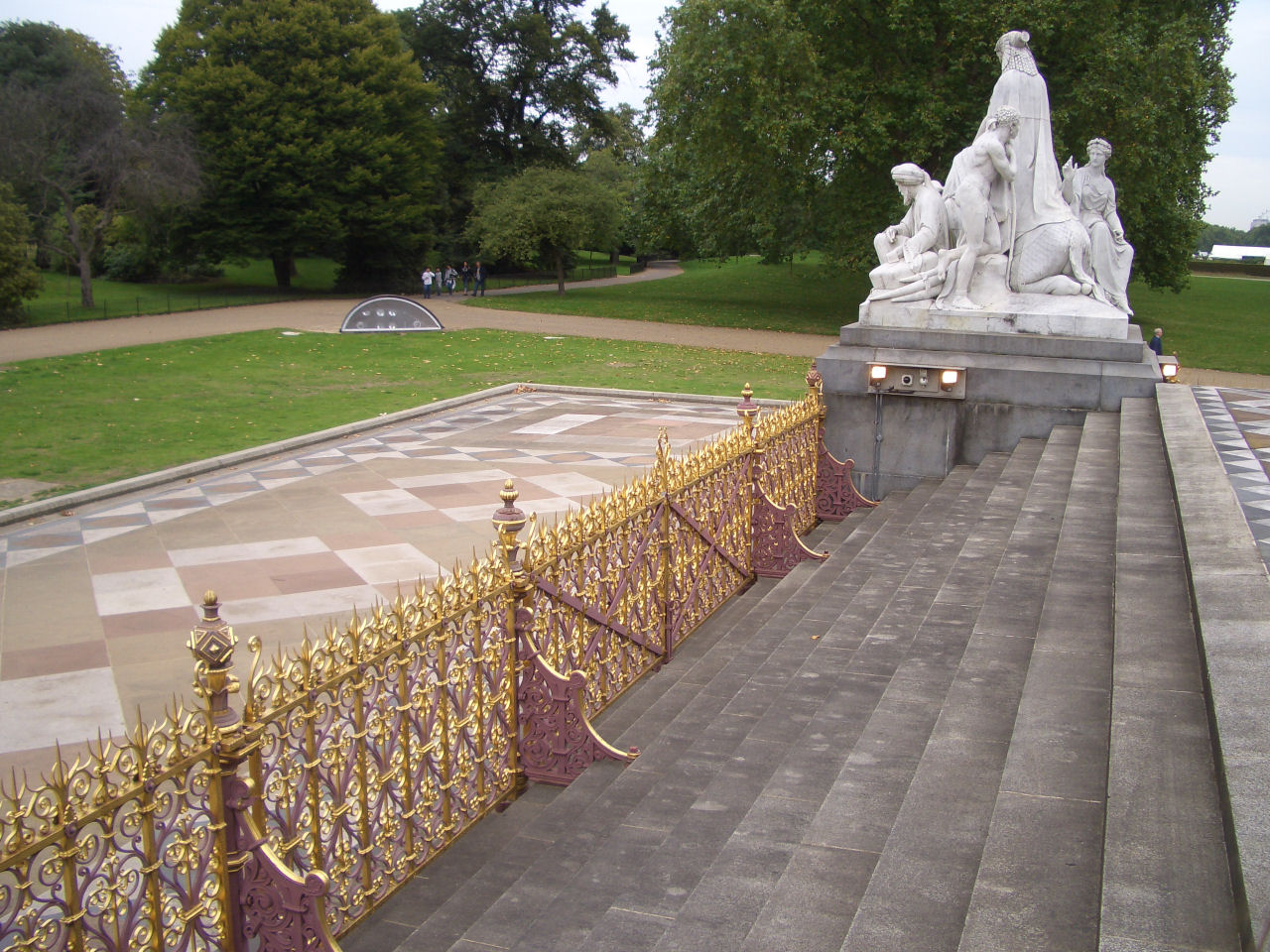
There was elephant for Asia:a camel for Africa:and a bison for America:We heard that underneath the base of the memorial is lots of concrete as well as numerous supporting brick arches. The stone for the memorial came from all over the British Isles and we heard where the different coloured stone for the base came from (something I'd never thought about whenever I've walked across them):The group was led further around the base and shown more details on the statues and the mosaics. It was interesting to learn that the north face focusses on architecture and the mosaic shows someone holding up the plans to the memorial itself!The group were now allowed to go beyond the railings and up the steps of the memorial.
This was the best bit of the tour because it meant that we could have a close-up look at the detailed carvings. Around the base of the memorial there was an intricate series of carvings depicting famous artists, architects, sculptors, musicians and writers. This carving was performed on site over a period of 4 years! Here's an example of the series of famous architects:
Being closer also allowed us a closer look at the centrepiece - the statue of Albert himself. This was made of bronze and covered in gold-leaf. It was added to the monument years after the building work was completed because there was such a debate over what the statue should look like. It was chosen that he'd wear the uniform of the Order of the Garter which is why he has a prominent garter on his leg:
He is also holding a catalogue of the Great Exhibition which he organised (you can even read the title on the front):
After a few more explanations about statues etc our hour long tour ended. We all felt we had a much better appreciation of this amazing memorial.

Summary: Lots of detail to see if you know what you're looking at.

Monday, 23 August 2010

Bank of England Museum

Website: http://www.bankofengland.co.uk/education/museum

Today I visited the Bank of England Museum on Threadneedle Street in the heart of the City of London. This museum is only open on weekdays so it's taken me a while to fit in a visit.

I didn't know where to go so ended up asking in the actual Bank of England. The doormen politely directed me around the corner to the actual museum. After a security check I picked up a guide pamphlet and set off.

The first stop was a surreal room that was made to look like the original Bank of England banking room from the 1800s. This included wooden counters and original decorations on the walls. The surreal thing was that in the centre of the room was a very modern exhibition about inflation called "The Pound in Your Pocket". Not sure where to start I read a few bits and pieces and tried to better understand inflation. Since 1992 one of the Bank of England's main jobs has been to keep inflation at 2%. They've had mixed success at this and the exhibition was heavily slanted towards explaining how difficult this task is.

At the side of the room were display cases exhibiting original, mint condition, coins from the last few hundred years. These included some from Queen Victoria:The exhibitions in the museum were arranged in chronological order but it was difficult to tell where to go to follow it in the right order. I took the next section in reverse. I learned all about the modern security measures in bank notes. I was impressed to use their testing equipment to see an ultra-violet "20" on the £20 note I had with me. From a computerised display I learned all about inflation and the difficulties it can cause if it's too high or too low. I also saw a printing press for bank notes: The next stop was a circular room which described the history of the Bank of England from the 1800s to the 20th century. I was lucky enough to follow it in the right order and found it all very interesting. I learned all about the Gold Standard (when the value of UK pounds was linked directly to a certain amount of gold in the Bank of England's vaults), as well as the financial turmoil caused by the first and second World Wars. Gradually it was explained how the current Bank of England emerged in the form it is today.

In the centre of the room was a collection of portraits of the Queen that have adorned bank notes over the past few decades. There was also a real bar of gold! This was in a plastic box and you could reach your hand in and lift it up. I have never held a bar of gold before and really had to struggle to lift it - it was very heavy! It was worth around £315,000.

After the round room I reached another room about the history of bank notes. This explained that they started as notes explaining how much gold you were entitled to from the vaults. If there were big disasters there'd be a run on gold - everyone would cash in their notes and get gold instead. The modern bank notes have evolved from those and no longer entitle the bearer to any gold unfortunately!After that I retraced my steps to the room I should have gone in first. This contained the early history of the Bank of England. I also came across the line-portraits that appear on current bank notes:
I emerged from the museum knowing a lot more about currency, money and central banks.

Summary: Interesting museum if you can make it on a weekday.

Saturday, 17 July 2010

See some plays: Spring Storm

Website: http://www.nationaltheatre.org.uk

Last night ABJ and I went to see the Tennessee Williams play Spring Storm at the National Theatre. The play was in the smaller Cottesloe Theatre which we had to hunt around to find.

Apparently the play was written when the young Tennessee Williams was in a writing class but the teachers and students were so negative about it that he put it away and it was only rediscovered after his death.

While I was waiting for ABJ I saw a "Watch This Space" performance by a troupe of jugglers in the area outside the theatre:
The play showed hints of Tennessee Williams' later works and was a story about a love triangle in the American South. The actors all spoke with a southern accent which made it fun to imagine what their real accents were.

The set and the set changes were very impressive - the set was a kind of squashed house and the set changers involved energetic people running in and restructuring the debris into a library or a living room.Summary: Good early Tennessee Williams.

Wednesday, 14 July 2010

See some plays: The Prisoner of Second Avenue

Website:
http://www.oldvictheatre.com/whatson.php?id=65
http://www.vaudeville-theatre.co.uk

On Monday night ABJ and I went to see The Prisoner of Second Avenue at the Vaudeville Theatre. We both enjoyed it immensely.

The play starred Jeff Goldblum and Mercedes Ruehl as Mel and Edna, a couple living on the 14th floor of an apartment block in New York City. Mel is anxious and neurotic about living in New York - the noise, the pollution, the faulty apartment - and during the play he has a nervous breakdown. In the end Edna and Mel realise what's important in life and end up somewhat happy again.

The play was laugh-out-loud funny and the performances were excellent. ABJ especially enjoyed the portrayal of Mel's Jewish
New Yorker family.

Sometime during the first act Mel went berserk and threw things around the stage. A pillow he threw landed up on the lighting and during the interval someone had to come out with a grabbing arm and retrieve it:
After the show we wanted to find something to eat and as we walked around trying to find a restaurant we stumbled upon the theatre's stage door. There was a crowd of people waiting there for Jeff Goldblum's autograph. We decided to wait to see what would happen. After about 10 minutes the actors started to come out. When Jeff came out he was mobbed by the fans but he was a very nice guy - he took time to sign everyone's tickets/flyers/hands and even posed for photos with people. One person said "You inspired me to go to acting school!" to which he replied "Oh, acting school?... I think I'm still in acting school...". ABJ managed to get one of our tickets signed.
Summary: Great play with great performances...

Monday, 12 July 2010

See some plays: Dandy of the Underworld

Website: http://www.sohotheatre.com

About a week and a half ago ABJ and I went to see a play called "Dandy in the Underworld" at the Soho Theatre. It was based on the memoir of Sebastian Horsley - a man who lived an extravagant life in the heart of Soho. The play had been in the news because a day after it opened Horsley was found dead at his home from a suspected drugs overdose. ABJ and I didn't know much about him when we booked into see the play but but the end we felt much more knowledgeable.

The play was a single-act that lasted something over an hour. The one actor played Horsley as he hung around his Soho flat getting ready to go out for lunch. He talked about his life, his past and his experiences with sex and drugs. The script was funny and poignant in turns.

The actor managed to keep everyone's attention for the whole play, whether he was getting dressed in a bright-red suit with bright-red top hat, or shouting out the window at noisy drug dealers or prostitutes...

We both enjoyed the show so much that when we left ABJ bought the book that's it's based on.Summary: An enjoyable night out...

Thursday, 1 July 2010

Tate modern restaurant

Website: http://www.tate.org.uk/modern/eatanddrink/restaurant.htm

Last Saturday ABJ and I ate lunch at the restaurant at the top of the Tate modern.

I'd heard that there were wonderful views from the top and I'd even heard rumours that there was a restaurant at the very top of the Tate modern tower. In reality the restaurant is on Level 7 of the art gallery. This was high enough to get good views as well as make it a lengthy procedure to get there in the lifts:We arrived and asked for a table for two near a window. This we promptly received although not on the river-side but on the opposite side with views over the modern architecture at the rear of the gallery. Unforunately the bright summer sun was reflecting off a glass roof outside and blinded anyone sitting at our table. We tried moving but the problem followed us as the sun moved in the sky. At last the waitress lowered the blinds to save our eyes...The food we ordered was very tasty and we were enjoying it so much we ordered dessert.Summary: Good views, tasty food.